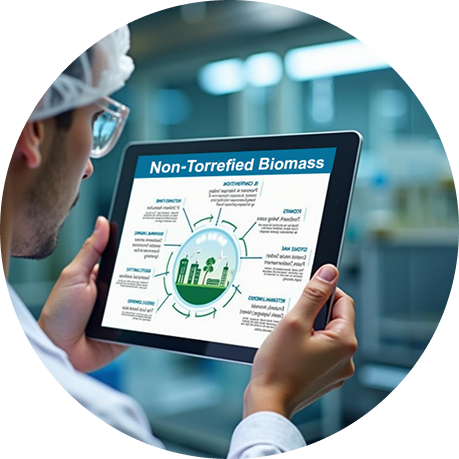
Non-torrefied biomass refers to raw or minimally processed organic material used for energy production, industrial applications, and agricultural purposes. Unlike torrefied biomass, which undergoes a thermal treatment to enhance its properties, non-torrefied biomass retains its natural composition, including moisture and volatile components.
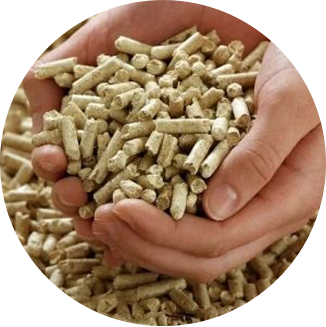
Direct Combustion – Used as a fuel in boilers, stoves, and furnaces for heating and power generation.
Pellet Production – Raw biomass can be compressed into pellets or briquettes, though these often require additional drying.
Agricultural Use – Frequently utilized as animal bedding, compost material, or feedstock for biofertilizers.
Biogas Production – Non-torrefied biomass can be processed in anaerobic digesters to produce biogas and organic fertilizers.
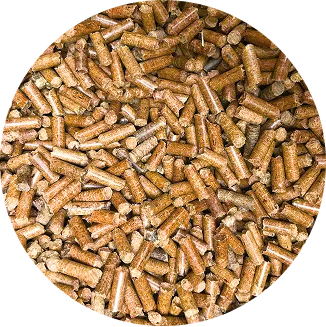
While non-torrefied biomass is a widely available and renewable resource, its limitations hinder its efficiency in energy applications. High transportation and storage costs, lower energy output, and susceptibility to degradation pose significant challenges. Additionally, its high moisture content reduces its combustion efficiency, making it less desirable for industrial-scale energy production.
Improving the usability of non-torrefied biomass through drying, densification, or blending with other fuels can enhance its potential as a sustainable energy source. As the demand for renewable energy grows, continued research and innovation will be crucial in maximizing the benefits of non-torrefied biomass while mitigating its drawbacks.
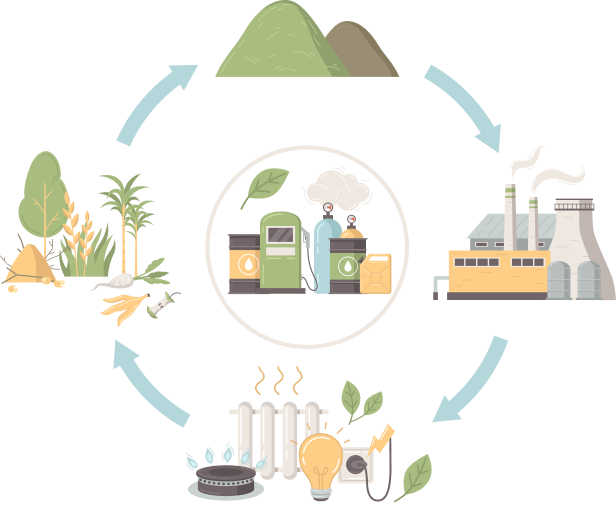
Non-torrefied biomass contains a significant amount of moisture, which reduces its combustion efficiency and increases transportation costs.
Due to its natural state, non-torrefied biomass has a lower energy content per unit mass compared to torrefied or fossil-based fuels.
Non-torrefied biomass tends to be fibrous and tough, making it more challenging to grind into fine particles for use in industrial processes.
The presence of moisture makes non-torrefied biomass more prone to microbial degradation and mold growth, leading to storage and handling issues.
Non-torrefied biomass absorbs water easily, which can negatively impact its storage and combustion performance.
GreenTure Marketing Pvt. Ltd is dedicated to sustaining innovation along with excellence and endeavors to offer eco-friendly sources of energy that would lead to cleaner environments and sustainable future.


 Office No: 428 4th Floor, Orbit Plaza, Crossings Republics, Ghaziabad - 201016
 91-8076-148767
,
91-7457-875757
91-8076-148767
,
91-7457-875757